
HIGH-TECH LABCOURSES
HIGH-TECH
LABCOURSES
Initiation to fluid turbulence
Turbulence is a canonical example of multi scale phenomenon. This multi scale character is actually at the very center of the phenomenological theory of turbulence by Kolmogorov.
During this lab course, the trainees will be initiated to two measurement techniques used for the spatial mapping of a flow, that will be illustrated through the study of the wake development behind a cylinder, a classical study case of turbulence.
PREREQUISITE
This lab-course is well suited to L3 and Master students with background skills in fluid mechanics and turbulence
DESCRIPTION
EXPERIMENTAL FLUID MECHANICS: observing turbulence using hot wire anemometry and particle image velocimetry (PIV)
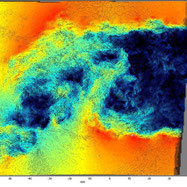
This module aims at initiating the participants to the principle and use of hot wire anemometry and PIV, two key techniques used in experimental fluid mechanics. The basics of measurement and signal processing are explained and applied to a classical study case in which the students observe the development of turbulence in the wake of a cylinder placed in a laminar flow. On one hand, PIV measurements provide instantaneous pictures of the flow enabling to observe the unsteady separated flow behind the bluff body and calculate basic statistical quantities such as the mean velocity and turbulent quantities. On the other hand, hot wire anemometry provides time resolved quantities. Thanks to their spectral analysis, the frequencies characteristic of the shedding vortices in the wake (Strouhal number) and of the smaller scales of turbulence (Kolmogorov scale) can be obtained. Transversal scans also show the downstream development of the wake and illustrate the turbulent diffusion of momentum.



LOCATION
Laboratory LEGI
1211 rue de la piscine
(see map below)